News
Telling stories of trauma and homelessness through co-designed comics
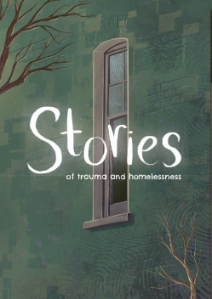
Homelessness is not a lifestyle choice. It often reflects multiple things going wrong and not having the support in place to respond and manage. Becoming homeless and the circumstances faced while homeless can be deeply traumatic, leading to people feeling isolated or at fault. Starting conversations about these experiences can be difficult, for both those affected and the providers supporting them.
Over the past few years, Emma Adams, a researcher at Fuse has been undertaking qualitative research, collaboratively with people with lived and living experience of homelessness, to explore trauma. Although this work has been funded through her NIHR Doctoral Fellowship, Emma's research journey with Fuse began in 2020 as an NIHR School for Public Health Research (SPHR) Pre-Doctoral Fellow and has since progressed into doctoral research focused on homelessness and trauma.
Working closely with two people with lived experience, Emma explored how people understood, responded to, and managed experiences of trauma. From speaking with 26 people who had experienced homelessness in North East England, two common patterns emerged in how people responded to current or recent traumatic experiences. Drawing on feedback from the people with lived experience who contributed to the project, Emma developed the stories of Sam and Alex. While these stories were initially created as written text, early conversations led to the decision to translate these into comics. With one person with lived experience sharing:
“Comics are a very versatile medium ideal for highlighting the tone and mood of a situation or deliver a wealth of information without needing to bombard people with pages of writing.”
Collaborating with non-profit design company Roots and Wings and colleagues from Newcastle University’s Open Lab, Emma set out to bring the stories to life through a series of workshop discussions with practitioners, providers and people with lived experience. Insights from these workshops informed the creation of the comics. The comics tell the stories of Sam, whose trauma is ongoing and recurrent, and Alex, whose trauma is shaped by the sudden shock of homelessness. These stories pull together the experiences of people who took part in the research study, and unfortunately are typical of many journeys while homeless. Emma provided a quote to reflect on the process of taking the stories from written text to visual forms:
“Determining how to visualise specific experiences in such a way that they remained true to the people whose stories were captured while broadening out to be reflective of other people’s journeys required considering not only which quotes to retain in the comics, but also careful reflection on how we specifically depicted Sam and Alex.”
The comics are designed to increase understanding about trauma during homelessness and support conversations about how situations and responses could be improved. Each comic contains prompts to help guide discussions. There has already been interest from providers looking to use the comics as part of training efforts. The comics may also be useful for training staff and students, or for supporting conversations with people experiencing homelessness where appropriate. While the comics cannot reflect every individual experience, they offer a starting point for raising awareness of trauma and its impact while someone is homeless. One provider shared:
“The comics have been a helpful resource to examine the trauma, challenges, and complexities that people experiencing homelessness navigate daily. The stories of Alex and Sam are common experiences that our clients go through, and the creativity of the comics have brought upon valuable and reflective conversations amongst our teams and have given us different perspectives to consider in our work.”
Someone else with lived experience explained:
“Having a visual comic that can be read and looked through in a safe place can help many of us on our journeys whilst also helping those that may be helping us, on our journey talk safely about our experiences. The comic makes you feel less alone as trauma numbs many of us, hopefully with the comic and the right support you can finally feel and start your journey to heal.”
Please note the comics may be distressing, and one story may be more appropriate than the other depending on the audience. Practitioners and providers should use their best judgement when deciding whether to use these comics with the people they support.
A select number of copies are available as physical printed copies, but below you can find links to freely downloadable digital versions. In addition, the individual stories are available as a larger single image poster. All material is available under a CC-BY license, and anyone wishing to speak with Emma directly can contact her at emma.adams@newcastle.ac.uk.
Downloads
Comics (PDF)
- Comic – Stories of trauma and homelessness – Alex
- Comic – Stories of trauma and homelessness – Sam
- Joint Comics – Storires of trauma and homelessness – Alex and Sam
Posters (JPG)
- Poster – Stories of trauma and homelessness – Alex
- Poster – Stories of trauma and homelessness – Sam
Acknowledgement
Thank you to the people experiencing homelessness who took part in this study and shared their stories, which have been used to create Sam and Alex. As well as a huge thanks to the people who contributed to developing the comics.
Special thanks to Alan and Olga from Roots and Wings for bringing the comics to life.
The comics have been developed as part of an NIHR Doctoral Fellowship. Emma Adams (NIHR Doctoral Fellowship, NU-010978) was funded by the National Institute for Health and Care Research (NIHR) for this research project. The views expressed in this publication are those of the author(s) and not necessarily those of the NIHR, NHS, or the UK Department of Health and Social Care.
Last modified: Mon, 02 Nov 2026 13:06:06 GMT