Fuse Translational Research Toolkit
 This toolkit supports Fuse members to plan and deliver Translational Research (TR) and Knowledge Mobilisation (KM). It brings together key definitions, practical guidance, and links to tools, contacts, and resources that help turn research into real-world impact.
Please click on the expandable content below.
About this Toolkit
About this Toolkit
This toolkit supports Fuse members to plan and deliver Translational Research (TR) and Knowledge Mobilisation (KM). It brings together key definitions, practical guidance, and links to tools, contacts, and resources that help turn research into real-world impact.
Turning public health research and evidence into real-world impact
Translational research (TR) bridges the gap between academic evidence and practice, ensuring findings make a difference for communities, practitioners, and policy makers. Fuse has over a decade of experience in TR and knowledge mobilisation (KM). Fuse works with international, national, and regional partners to enhance the reach and impact of public health research.
This toolkit offers practical ways to translate your research and evidence into action, drawing on Fuse’s model and wider National Institute for Health and Care Research (NIHR), local authority and NHS resources. The purpose of this toolkit is to support Fuse members in research and practice settings by enabling, equipping and embedding the translation of evidence into impact.
For maximum impact, TR and KM should be planned from the start of your research project and can continue beyond its completion. It is good practice to cost in KM and dissemination activities when developing funding bids to support effective knowledge exchange and implementation.
Defining Translational Research and Knowledge Mobilisation
To help you make the most of this toolkit, it is useful to understand how Fuse defines two key concepts:
Translational Research (TR)
The process of applying ideas, insights, and discoveries generated through basic scientific inquiry to the treatment or prevention of human disease.
- University of Cambridge, Office for Translational Research
Knowledge Mobilisation (KM)
Knowledge Mobilisation is about connecting and encouraging people to share explicit and tacit knowledge and to use this knowledge to inform decision making and impact on policy and practice. It is an art and a science.
- NHS Knowledge and Library Services, Health Education England
How do we translate public health research?
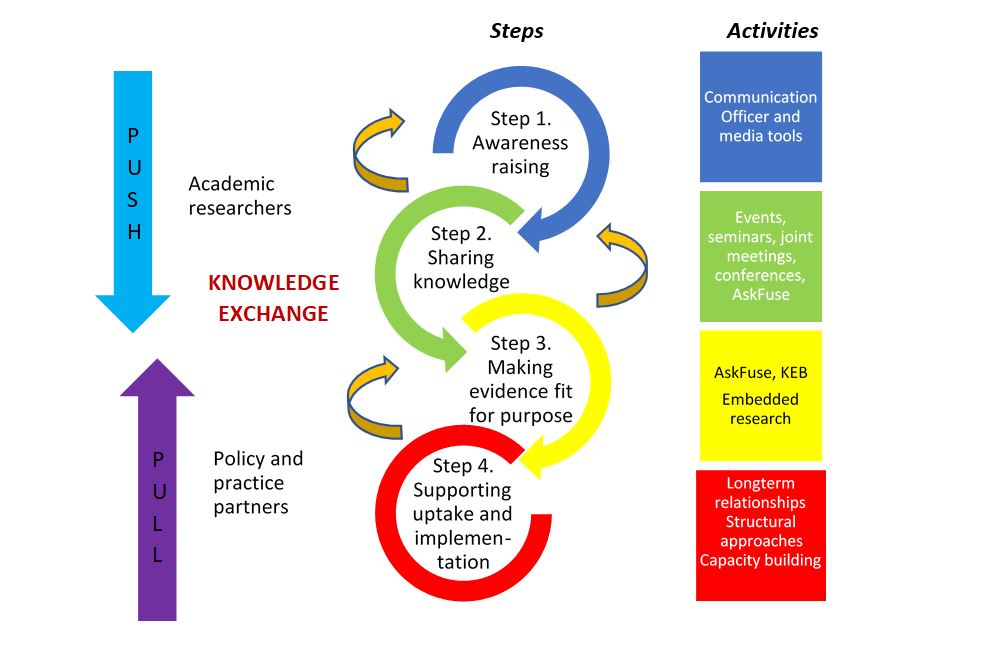
Fuse translates research through four interconnected steps, based on the Fuse Knowledge Exchange model (van der Graaf et al., 2020):
- Awareness raising – making research visible and accessible
- Knowledge sharing – building networks and learning together
- Making evidence fit for purpose – tailoring and localising research to meet user needs
- Supporting uptake and implementation – helping others use and apply research findings.
Awareness raising
Fuse promotes research through creative communication and storytelling.
Tools and resources you can use to raise awareness of your research:
- Website: news stories and case studies
- Social media: LinkedIn, Bluesky or X (formerly Twitter)
- E-newsletter inFuse
- Podcast: Public Health Research and Me
- Research briefs: short, accessible summaries of your work
- Fuse Open Science Blog: informally share your experience with a wider audience
- Press/media work: impactful research of interest to the public
- Other creative methods: e.g. video of how Fuse is creatively communicating research
Practical actions:
- Write a research case study
- Create a Fuse brief (we have a template)
- Write a blog post (guidance here)
- Record a podcast (work with the Fuse Public Partner Network)
- Collaborate with the Fuse Communications Manager to adapt your research outputs for the most suitable channel and creative method
- Suggest media stories or highlight news for inFuse and other platforms.
Top tips:
- Work with the Communications Manager to ensure messaging is clear, consistent, and reaches the right audiences
- Plan early - think about which tools are best suited for your audience and outputs (see also Practical actions under step 3 - Making Evidence Fit for Purpose).
Knowledge sharing
Fuse connects researchers, practitioners, policy makers, public partners, and communities through collaborative events, dialogue, and networks to share research and make sense of different types of knowledge.
Tools and resources you can use for knowledge sharing:
- Fuse events, international conferences, workshops and seminars (ask about our guide to planning your Fuse Research Event)
- Communities of Practice (CoPs): Peer Research NENC, Embedded Researchers In Councils (ERIC), Creative Methods
- Networks: Physical Activity Network, NIHR SPHR Network for Health and Risk Communication for Public Health
- Fuse Public Involvement and Engagement (PIE) support.
Practical actions:
- Co-organise or participate in events and conferences - invite relevant stakeholders including public partners
- Join CoPs to share insights and learn from peers
- Engage with PIE support:
-
- One-to-one guidance from the Fuse Public Involvement and Engagement Manager on involvement and engagement activities
- Tools to plan and record public involvement in research
- Connect with relevant networks, organisations, and contacts
- Collaborate with the Fuse Public Partner Network.
-
Top tip:
Treat knowledge sharing as a two-way process: contribute, listen, and learn simultaneously. Think about accessibility of your knowledge mobilisation in terms of inclusion, health literacy and knowledge equity (see resources).
Making evidence fit for purpose
Fuse helps researchers ensure evidence is accessible, relevant, timely, and co-produced with stakeholders.
Tools and resources you can use to make evidence fit for purpose:
- AskFuse (run by AskFuse Research Associate Lesley Haley)
- Embedded researchers
- Public involvement to co-design outputs and approaches.
Practical actions:
- Respond to AskFuse enquiries and submit your own enquiries
- Consider embedded research roles as part of research projects and funding applications (expertise availability through the Fuse Embedded Research in Councils network)
- Develop a Knowledge Mobilisation (KM) plan using:
- Work with AskFuse and the Fuse Public Involvement Engagement to:
-
- Ensure outputs meet community and stakeholder needs
- Plan and record public engagement activities
- Connect outputs to relevant networks or partners.
-
Top tip:
Plan for translation from the start of your research, thinking about how findings could be used and by who - including public contributors.
Supporting uptake and implementation
Fuse helps partners apply evidence in practice through collaboration, training, and capacity building.
Resources and tool to support uptake and implementation:
- Join the Fuse Community of Practice on Creative Research, Involvement and Dissemination
- Online and in-person Knowledge Mobilisation (KM) training resources (see resource list)
- Case study template for monitoring impact.
Practical activities:
- Participate in training and workshops to enhance your translational research skills
- Build long-term relationships between practitioners, policy makers and communities by including them early in your research ideas
- Spend time in other organisations (e.g. through shadowing, placements, exchanges and becoming an embedded researcher)
- Apply for funding to support KM activities (e.g. Impact Accelerator Fund for NIHR School for Public Health Research (SPHR) funded research)
- Build KM activities into your funding applications
- Develop and share impact case studies from AskFuse, Research Clusters, and other projects to demonstrate translational Public Health in different settings and populations.
Top tip:
Translational research is not transactional but relational: invest up front in connections with practitioners, policy makers and communities to generate impact as your research develops.
Talk to us!
The Fuse core team are experts by experience. Bring your ideas, questions, or challenges - we’re here to help you make your research matter.
Contact the Fuse core team:
- Fuse Communication Manager - Mark Welford, Teesside University, email: m.welford@tees.ac.uk
- Fuse Public Involvement and Engagement Manager - Ella Anderson, Newcastle University, email: eleanor.anderson@newcastle.ac.uk
- AskFuse Research Associate - Lesley Haley, Teesside University, email: l.haley@tees.ac.uk
- Fuse Centre Manager - Agata Robertson, Newcastle University, email: Agata.Robertson@newcastle.ac.uk
- Fuse Research Administrator - Cheryl Wiscombe, Newcastle University, email: cheryl.wiscombe@ncl.ac.uk
- For general enquiries, email: fuse@newcastle.ac.uk
Photo by Gabriella Clare Marino on Unsplash